Motorist Safety & Awareness.
When a Vehicle Breaks Down, Safety Comes First
A vehicle breakdown can happen without warning. A sudden loss of power, puncture, overheating engine or unexpected warning light can leave a driver dealing with an unfamiliar and stressful situation.
Understandably, attention often turns immediately to the vehicle. What has gone wrong? Can it be restarted? How much will the repair cost?
But there is another consideration that can easily be overlooked: the traffic and hazards surrounding the vehicle.
A broken-down car may be stationary, but the road around it is not.
The UK Highway Code provides guidance on stopping safely, leaving a vehicle, protecting passengers and requesting assistance.
One particularly useful technique deserves attention before anything else.
1. The Dutch Reach: Look Before You Open the Door
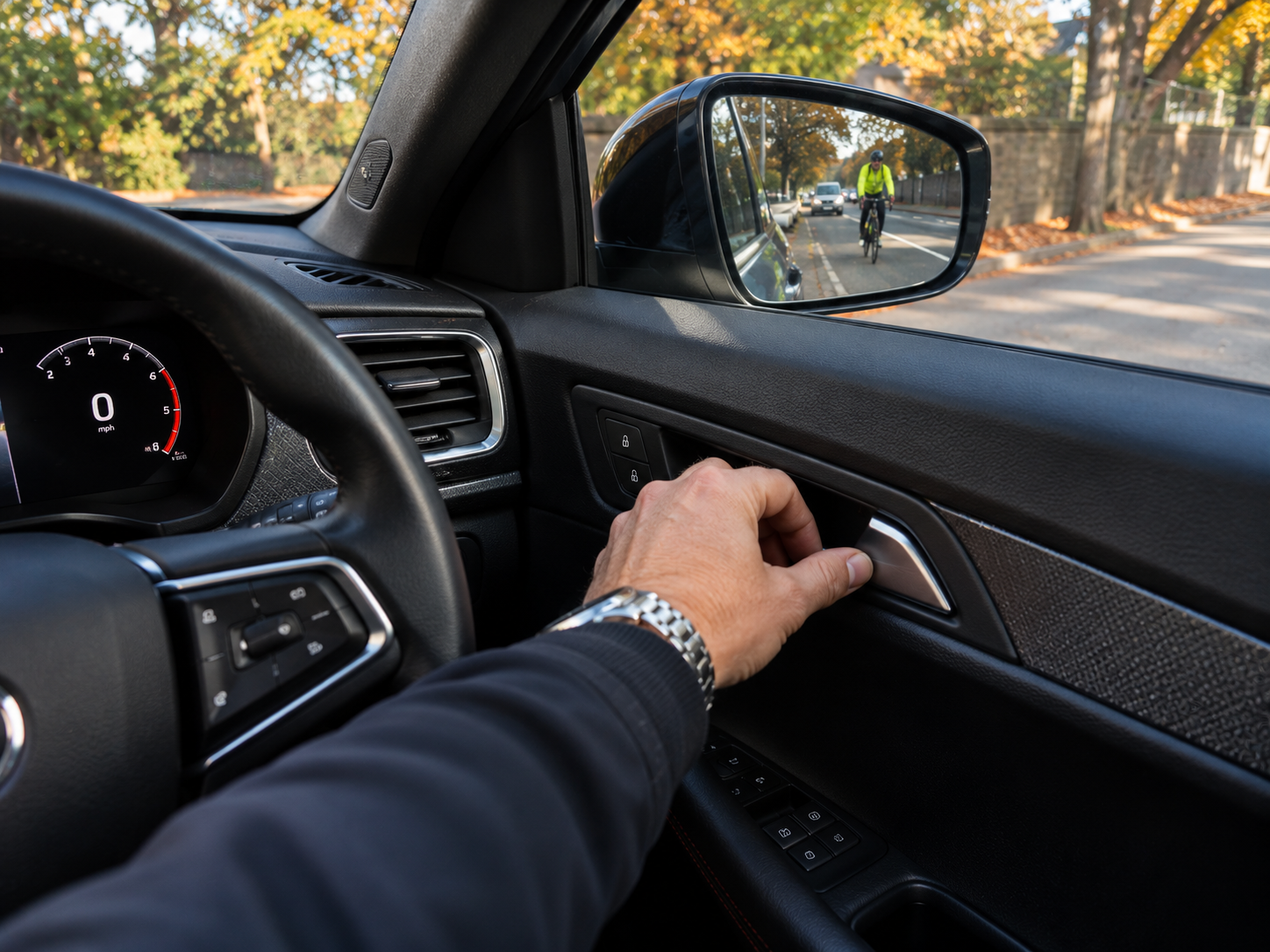
The Dutch Reach is a simple door-opening technique designed to encourage drivers and passengers to check their surroundings before stepping out.
It is particularly relevant during an unexpected breakdown, when attention may be focused on the vehicle rather than approaching traffic.
How does the Dutch Reach work?
Instead of opening the door with the hand nearest to it, use the opposite hand.
In a typical right-hand-drive UK vehicle:
The driver uses their left hand to reach for the door handle.
The movement encourages the upper body to turn towards the door.
This makes it easier to look over the shoulder and check for approaching cyclists, motorcyclists, vehicles and pedestrians.
Only open the door when it is safe.
For a passenger, the same principle applies: use the hand furthest from the door to encourage a shoulder check.
The technique is recommended under Highway Code Rule 239.
Why is this especially important during a breakdown?
A driver dealing with an unexpected mechanical failure may be distracted, frustrated or concerned about the vehicle.
That distraction can make it easier to forget ordinary safety checks.
Opening a door into the path of an approaching cyclist, motorcyclist or vehicle can cause serious injury.
The Dutch Reach encourages a deliberate moment of observation before leaving.
Reach across. Turn. Look. Check. Open only when safe.
Important: Motorway breakdowns are different
The Dutch Reach does not replace motorway emergency procedures.
On a motorway hard shoulder or emergency area, the Highway Code advises occupants to leave through the side furthest from moving traffic, where it is safe and possible.
If the vehicle has stopped on the left, this will normally mean using the left-hand doors.
Never open a door towards live traffic simply to perform the Dutch Reach.
If occupants cannot safely leave a vehicle stopped in a live motorway lane, they should remain inside with seat belts fastened, activate the hazard warning lights and call 999, asking for the police.
The principle is straightforward: the Dutch Reach helps you check before opening a door, but choosing a safe exit remains the priority.
2. Recognise the Problem and Find a Safer Place to Stop
If a vehicle develops a fault while moving, assess whether it can safely reach a suitable stopping location.
Where possible, aim for a service area, designated parking area, lay-by or another location away from moving traffic.
On a motorway, leaving at the next junction or entering a service area is preferable if the vehicle remains safe to drive.
If that is not possible, move left into an emergency area or onto the hard shoulder where available.
Once stopped:
Apply the parking brake and secure the vehicle.
Switch on the hazard warning lights.
Keep sidelights illuminated in darkness or poor visibility.
Avoid unnecessarily obstructing traffic where a safer stopping location is available.
If the vehicle is overheating, emitting smoke or showing signs of a serious mechanical failure, continuing to drive may create further risks.
The safest response depends on the circumstances.
3. Why Steering Wheel Position Matters
One precaution motorists may overlook is the position of the front wheels after stopping on a motorway hard shoulder or emergency area.
Highway Code Rule 277 advises drivers to stop as far to the left as possible, with the wheels turned to the left.
The intention is to direct the vehicle away from live traffic if it moves unexpectedly.
This is particularly relevant when a vehicle has stopped close to high-speed traffic.
However, this guidance should not be confused with the rules for parking on a hill.
Under Highway Code Rule 252, drivers parking uphill should generally turn their wheels away from the kerb, while drivers parking downhill should turn them towards the kerb.
Correct wheel positioning is an additional precaution, not a substitute for securing the vehicle with its parking brake and appropriate transmission setting.
4. Leaving the Vehicle: Use the Side Away From Traffic
Once the vehicle has stopped, deciding how to exit can be just as important as deciding where to stop.
On a motorway hard shoulder or in an emergency area, the Highway Code advises drivers and passengers to leave through the side furthest from moving traffic, where it is safe and possible.
Before opening a door, check the surroundings carefully.
Passengers should avoid stepping into a live traffic lane or standing between the vehicle and approaching traffic.
If it is safe to leave:
Move away from the vehicle and the carriageway.
Wear high-visibility clothing if available.
Stand behind a safety barrier where one exists, after checking for hazards such as drops or uneven ground.
Keep children under close supervision.
Do not return to the vehicle while waiting for assistance.
The Highway Code also warns against standing where the vehicle could be pushed into people if struck by passing traffic.
What if it is not safe to get out?
If a vehicle stops in a live motorway lane and its occupants cannot safely reach a place away from traffic, the Highway Code advises them to remain inside, keep their seat belts fastened, activate the hazard warning lights and call 999 immediately, asking for the police.
The same emergency approach applies when occupants cannot safely leave the vehicle and reach a place of relative safety.
The decision to exit must always take account of the immediate danger outside.
5. Warning Triangles: Useful on Some Roads, Dangerous on Motorways
A warning triangle can help alert approaching drivers to a stationary vehicle, but its use depends on the road.
Under Highway Code Rule 276, a warning triangle should be positioned at least 45 metres behind a broken-down vehicle on the same side of an ordinary road, where it is safe to do so.
Never place a warning triangle on a motorway.
Walking along or entering a high-speed carriageway to position warning equipment can expose a motorist to serious danger.
Hazard warning lights, appropriate vehicle positioning and moving occupants to a place of relative safety are the more important precautions.
Drivers should never put themselves at risk to retrieve or deploy roadside equipment.
6. Avoid Attempting Repairs Beside High-Speed Traffic
Some mechanical problems may appear straightforward.
A flat tyre, loose component or discharged battery might normally be manageable in a safe location.
However, the environment changes the level of risk.
The Highway Code advises motorists not to attempt repairs on a motorway hard shoulder or emergency area.
Even a brief task may require someone to stand beside the vehicle, open the bonnet or move into an exposed position.
A passing vehicle, unexpected movement or poor visibility can make that position dangerous.
The safer approach is to move away from traffic and arrange appropriate assistance.
7. Calling for Assistance: Make Your Location Clear
When requesting roadside assistance, accurate location information is important.
Drivers should try to provide:
The road name or motorway number.
The direction of travel.
A nearby junction, exit or recognisable landmark.
A motorway marker post or driver location sign, where available.
The vehicle's registration and a description of the problem.
Any immediate hazards, passengers requiring assistance or difficulty reaching safety.
Mobile mapping applications can help identify a location.
On motorways, emergency roadside telephones can also connect motorists with the appropriate road operator.
If someone is injured, there is immediate danger, or occupants cannot safely leave a vehicle stopped in a live motorway lane, call 999.
A breakdown assistance request should not delay contacting emergency services when there is an immediate threat to life or safety.
8. Before the Next Journey: A Few Sensible Preparations
Although not every breakdown is preventable, motorists can reduce avoidable problems through routine vehicle maintenance.
Tyre condition and inflation pressure, engine oil, coolant, battery condition and warning lights all deserve attention.
For longer journeys, keeping a charged mobile phone, suitable clothing and basic emergency equipment in the vehicle may also be useful.
A high-visibility vest should ideally be accessible without having to stand beside traffic or search through the boot.
Vehicle maintenance and roadside preparedness serve different purposes, but both contribute to safer journeys.
What Motorists Should Remember
A breakdown is often inconvenient, but the surrounding traffic can present a greater immediate risk than the mechanical fault itself.
The essential principles are to reach a safer stopping place where possible, make the vehicle visible, secure it appropriately, leave through the safer side when conditions permit and keep clear of moving traffic.
The Dutch Reach is a useful everyday habit because it encourages motorists to check before opening a door, including when distracted by a breakdown.
Motorway breakdowns require particular caution.
Understanding when to turn the wheels left, why warning triangles must not be used on motorways and how to open a vehicle door safely can make a meaningful difference.
The priority is not to get the vehicle moving again as quickly as possible. It is to make sure everyone remains safe while help is arranged.
Official Sources and Further Reading
The Highway Code — Breakdowns and Incidents, Rules 275–287
https://www.gov.uk/guidance/the-highway-code/breakdowns-and-incidents-274-to-287
The Highway Code — Waiting and Parking, Rules 239 and 252
https://www.gov.uk/guidance/the-highway-code/waiting-and-parking-238-to-252
The Highway Code — Motorways
https://www.gov.uk/guidance/the-highway-code/motorways-253-to-273
Department for Transport — The Highway Code: Changes Including the Dutch Reach
https://www.gov.uk/government/news/the-highway-code-8-changes-you-need-to-know-from-29-january-2022
THINK! — Vehicle Safety Checks and Breakdown Guidance
https://www.think.gov.uk/campaign/vehicle-safety-checks/
Disclaimer
This article has been prepared using publicly available information from official organisations, industry publications and other publicly accessible sources available at the time of publication.
The ROBELIUM Newsroom provides editorial summaries intended to support general awareness of developments within the transport, mobility and roadside assistance sectors. Content does not constitute live traffic management, operational forecasting, route guidance, legal advice, safety advice or professional advice.
ROBELIUM is not affiliated with, endorsed by, or acting on behalf of any official transport authority, public body, road operator, emergency service or third-party organisation referenced in this article, unless explicitly stated.
Information, planned works, transport conditions and public announcements may change following publication. Readers should refer to the relevant official authority or original source for the latest updates where appropriate.