
Overview
Connected vehicles are generating increasing amounts of information relating to vehicle operation, system status and use.
Recent public material from the UK Government and European Commission shows continuing regulatory and policy attention around how transport and vehicle-generated data can be accessed, shared and governed.
In the UK, research published by the Department for Business and Trade and Department for Transport in June 2026 examined potential Smart Data applications across the transport sector. Separately, European guidance accompanying the EU Data Act addresses access rules for data generated by connected vehicles.
For the wider automotive and roadside assistance sectors, these developments provide observable signals around the growing role of data alongside the physical vehicle.
Observed Activity
The UK Government's 2026 transport Smart Data research examined how improved movement of information could address existing challenges across transport.
The research involved three stakeholder workshops with 112 representatives from across the transport ecosystem.
Participants identified fragmentation of transport data across organisations, modes and sectors. The report described both technical barriers — including inconsistent formats, incompatible systems and limited common standards — and institutional barriers involving governance, liability, incentives and restrictions on data sharing.
Twelve potential Smart Data use cases were identified across areas including journey planning, electric vehicle charging, network management, freight and logistics.
The research remains exploratory and does not represent confirmed government policy proposals.
Vehicle Data Access
Vehicle-generated data is also receiving specific attention at European level.
The European Commission published automotive-sector guidance alongside the EU Data Act in September 2025.
The guidance addresses how provisions within the Data Act apply to vehicle data and sets out information for automotive stakeholders including vehicle manufacturers, suppliers, aftermarket service providers and insurance providers.
The Data Act has applied since September 2025, with additional implementation material subsequently published by the European Commission.
These public materials place vehicle-generated information within a broader discussion concerning access rights, responsibilities and data use across the automotive ecosystem.
Recurring References
Across the UK research and European regulatory material, several recurring subjects are visible.
Interoperability
Public material repeatedly references the importance of systems and organisations being capable of exchanging information using workable technical standards.
Governance
Questions around who may access information, for what purpose and under which conditions remain central to transport data discussions.
Data access
Connected products, including vehicles, can generate information that may have relevance beyond the original manufacturer.
Trust and responsibility
Data sharing introduces considerations around security, appropriate use, liability and the interests of individuals and organisations associated with that information.
These themes extend beyond any individual automotive service and form part of a wider policy discussion around increasingly connected transport systems.
Operationally Relevant Signals
For roadside assistance and vehicle recovery, the relevance of connected vehicle data sits within the broader technological development of the vehicle fleet.
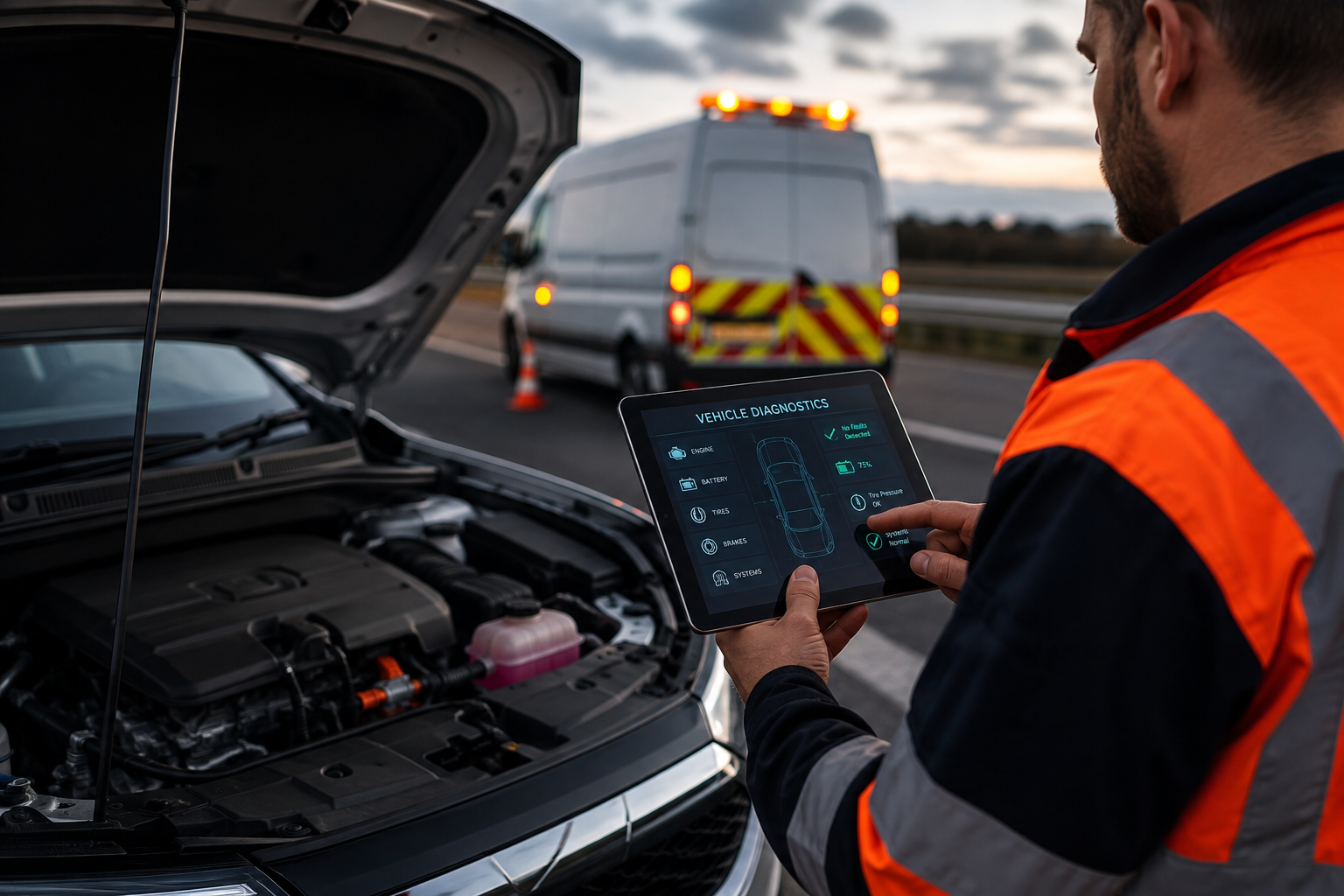
Modern vehicles increasingly incorporate digital systems capable of generating diagnostic, status and operational information.
At the same time, electric vehicles, connected services and software-dependent vehicle functions are becoming established parts of the automotive environment.
Public policy attention around vehicle-data access therefore sits alongside continuing changes in the technical characteristics of vehicles encountered by automotive service organisations.
The current public material does not establish a single model for how vehicle information will be used across roadside assistance.
It does, however, show that access, interoperability, governance and appropriate sharing of transport and vehicle-generated information are active areas of regulatory and industry consideration.
Current Position
The UK Government's transport Smart Data work remains at an exploratory stage.
Its June 2026 research states that further work will examine selected use cases, data availability, governance models, legal applicability and commercial implications.
The research also cautions that data sharing alone would not resolve wider transport-system challenges. Legacy technology, organisational capability, infrastructure and regulatory considerations remain relevant.
Within the European automotive sector, the Data Act provides a more developed framework around access to data from connected products, supported by vehicle-specific guidance from the European Commission.
Taken together, these developments provide a current public picture of a transport environment in which vehicle and mobility data is receiving increased policy and regulatory attention, while practical questions around access, standards and governance continue to be examined.
Source Types
This editorial summary draws on publicly available material including:
Department for Business and Trade and Department for Transport research on Smart Data opportunities within the transport sector, published June 2026;
UK Government Smart Data policy and research materials; and
European Commission guidance concerning vehicle data and implementation of the EU Data Act.
Disclaimer
This article has been prepared using publicly available information from company publications, official announcements, industry sources and other publicly accessible materials available at the time of publication.
The ROBELIUM Newsroom provides editorial summaries intended to support general awareness of developments within the transport, mobility, fleet and roadside assistance sectors. Content does not constitute investment advice, legal advice, technical advice, operational guidance or professional advice.
ROBELIUM is not affiliated with, endorsed by, or acting on behalf of any organisation referenced in this article, unless explicitly stated.
Information and public announcements may change following publication. Readers should refer to the relevant original source for the latest updates where appropriate.