Overview
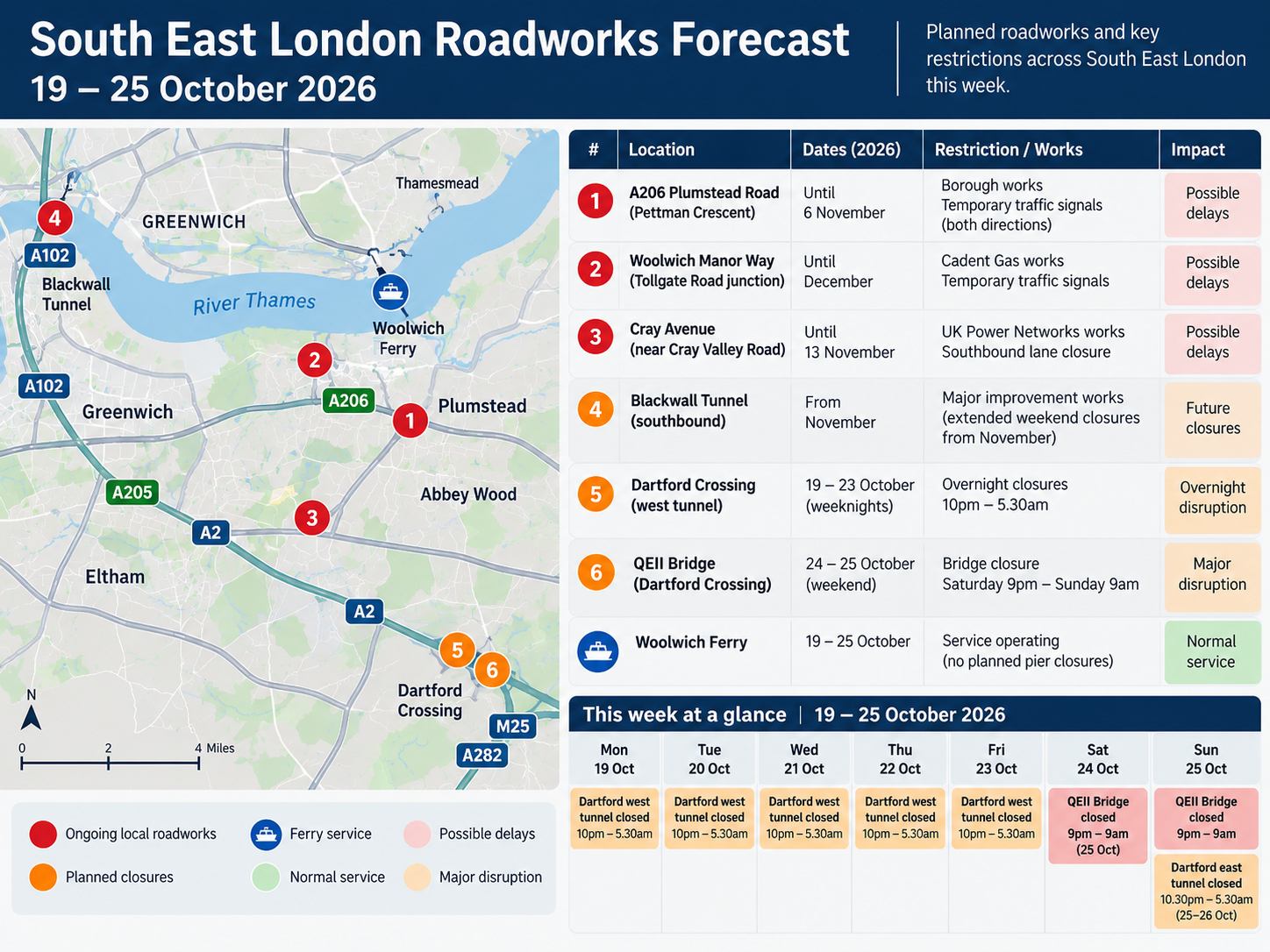
For drivers in South East London, the difficulty this week is unlikely to come from one major closure.
Instead, several separate restrictions are reducing capacity across roads that already carry substantial commuter, commercial and local traffic.
The A206 through Charlton, Woolwich and Plumstead, the A2 Old Kent Road, A21 Lewisham High Street and the approaches towards the Thames crossings remain the principal areas to watch.
Some shorter-duration works are approaching completion. Others — particularly the transformation of the A206 corridor associated with the Cycleway 4 extension — will remain part of the road environment well into 2027.
At the same time, London's approach to traffic enforcement is changing. New radar-based speed cameras capable of operating without traditional road markings or a visible flash are currently being trialled by Transport for London.
For motorists, South East London is therefore experiencing two changes simultaneously: physical changes to the road network and increasingly sophisticated enforcement of how that network is used.
Woolwich and the A206: disruption will continue
One of the most significant long-term projects remains the extension of Cycleway 4 from Greenwich towards Woolwich.
Construction began in summer 2025 and TfL expects the wider project to be completed during 2027.
Work includes a segregated cycle route along the A206, changes around Woolwich Ferry roundabout, pedestrian and cycle crossings, signal alterations and modifications to sections of carriageway and bus infrastructure.
The consequences for existing traffic are significant because the A206 is not simply a local road.
It forms an important east-west route through Greenwich, Charlton and Woolwich and also feeds traffic towards the Woolwich Ferry, Blackwall/Silvertown corridor and routes towards Thamesmead.
TfL currently lists restrictions on Woolwich Church Street around Woolwich Ferry roundabout running until 31 July 2027 while Cycleway 4 works continue.
This is therefore not a short-term roadworks problem.
Drivers should expect changing lane arrangements and temporary restrictions along this corridor as individual construction phases move forward.
Plumstead Road: September completion currently scheduled
Another current restriction affects the A206 Plumstead Road at Pettman Crescent.
Temporary traffic signals are operating while Greenwich Council carries out works, with an additional lane closure on Pettman Crescent.
TfL currently gives 21 September 2026 as the scheduled end date.
Although classified as a relatively limited restriction, this location matters because it sits on the same east-west corridor carrying traffic between Woolwich, Plumstead and Thamesmead.
Where several restrictions exist along one corridor, relatively small reductions in capacity can combine to produce considerably greater delays during busy periods.
Lewisham High Street: short-term restriction approaching completion
There is better news around Lewisham.
On the A21 Lewisham High Street, one of two northbound lanes between Ladywell Road and Legge Street has been closed for TfL works.
The current programme runs until Wednesday 19 August.
If the works finish as scheduled, this removes one current restriction from an important route feeding traffic between South East London and the South Circular.
As always with roadworks, published completion dates remain subject to operational change.
Old Kent Road: restrictions continue into September
The A2 Old Kent Road remains another corridor where drivers should allow additional time.
Southbound lane restrictions around Devonshire Grove are currently scheduled to remain until 4 September 2026.
The A2 is particularly sensitive to reduced capacity because it serves several different functions simultaneously: local traffic, buses, commercial vehicles and longer-distance movements towards New Cross, Greenwich and the wider South East London road network.
Construction activity also continues on New Kent Road, where the eastbound bus lane at Bartholomew Street is closed as part of works currently scheduled through to June 2027.
The result is a corridor where individual restrictions may appear relatively modest but can contribute to recurring congestion across a much larger area.
Blackwall and Silvertown: evidence of improvement
There has been measurable progress around one of South East London's historically difficult congestion points.
The Silvertown Tunnel opened in April 2025, providing an additional Thames crossing alongside Blackwall Tunnel.
TfL's first-year monitoring indicates that the combined tunnel system has improved journey reliability and reduced congestion on several approaches.
This is significant because Blackwall was previously highly vulnerable to disruption. An incident, breakdown or closure could rapidly create queues extending into Greenwich and surrounding roads.
However, the improvement is not uniform across the entire local network.
TfL's monitoring identifies slight increases in journey times on the A206 approaching the Woolwich Ferry during most periods.
There is an important complication: the same area is affected by the continuing Cycleway 4 construction programme.
It is therefore difficult to attribute every local journey-time change solely to the new tunnel arrangements.
For South East London drivers, the emerging picture is more nuanced than simply saying congestion has disappeared.
Blackwall has become more resilient, while pressure remains on several surrounding local corridors.
Woolwich Ferry
The Woolwich Ferry continues to provide an alternative Thames crossing between Woolwich and North Woolwich.
However, drivers using the ferry also have to negotiate the continuing construction environment around Woolwich Ferry roundabout.
The surrounding A206 works mean that even when the ferry itself is operating normally, access to the crossing can be affected by local traffic conditions.
Drivers relying on the ferry should therefore continue checking both ferry status and surrounding road conditions before travelling.
Dartford Crossing: overnight maintenance continues
The A282 Dartford Crossing remains another important consideration for drivers travelling around the eastern side of London.
National Highways continues its regular maintenance programme across the tunnels and QEII Bridge.
For the coming week, overnight tunnel closures are scheduled as part of that programme.
The east tunnel is scheduled to close overnight from Monday 17 August through Thursday, with further overnight restrictions programmed during the week.
Vehicles above the relevant height limits can be particularly affected when tunnel availability changes.
These works normally take place overnight specifically to reduce daytime disruption, but the Dartford Crossing carries very high traffic volumes and restrictions can still affect late-night commercial and long-distance journeys.
Drivers travelling overnight should check National Highways information before departure because closure arrangements can change.
A different generation of speed camera
Another change taking place across London is less visible than the roadworks.
TfL is trialling a new generation of radar-based speed enforcement cameras.
The technology combines 4D radar with a high-resolution colour camera and does not require the traditional road markings, embedded road sensors or visible flash associated with many older speed-camera installations.
Trials were announced for up to ten London locations, initially on roads with 20mph limits.
The purpose is to determine whether the equipment is suitable for London's future enforcement requirements.
TfL has subsequently confirmed that cameras used within the trial became operational for enforcement during April.
This does not mean that every existing camera in South East London is being replaced or that ten new permanent cameras are being installed specifically in the South East.
It does, however, indicate the likely direction of future speed enforcement.
If the trial proves successful, enforcement infrastructure could become less dependent on traditional fixed-camera layouts and road markings.
For drivers, the practical message is straightforward: the absence of familiar camera markings or a visible flash should increasingly not be interpreted as the absence of speed enforcement.
Why the network can still feel congested
There is an important difference between strategic network improvement and an individual driver's experience.
Silvertown Tunnel has added resilience to the Thames crossing network and TfL's monitoring indicates improvements around Blackwall.
Yet a driver travelling from Bexley or Thamesmead through Woolwich, Charlton, Greenwich, Lewisham or towards central London may still encounter several restrictions during a single journey.
A temporary signal at one location, a lane closure several kilometres later and construction at another junction can progressively reduce the ability of the network to recover between congestion points.
This is particularly noticeable on corridors such as the A206 where there are limited realistic alternatives for through traffic.
The result can appear contradictory:
a major strategic crossing becomes faster while some local journeys remain difficult.
Both can be true at the same time.
What is changing next
Several dates are worth watching.
19 August — scheduled completion of the current A21 Lewisham High Street restriction.
4 September — scheduled completion of the current A2 Old Kent Road restriction at Devonshire Grove.
21 September — scheduled completion of the current A206 Plumstead Road/Pettman Crescent works.
2027 — expected completion period for the wider Cycleway 4 extension towards Woolwich, with current restrictions around Woolwich Ferry roundabout listed into July 2027.
These dates should be treated as the currently published programme rather than guarantees. Utility discoveries, weather, construction requirements and changes to traffic management can alter completion schedules.
ROBELIUM Observation
South East London's road network is undergoing a significant transition.
The opening of Silvertown Tunnel has provided additional strategic capacity and early monitoring indicates meaningful improvements around Blackwall.
At street level, however, drivers continue to experience the effects of multiple overlapping infrastructure projects.
The A206 is particularly important.
It carries local journeys, commercial traffic and movements towards several Thames crossings while simultaneously undergoing substantial changes associated with walking and cycling infrastructure.
The practical difficulty for motorists is therefore often not one major closure but the cumulative effect of successive restrictions across the same journey.
At the same time, enforcement technology is evolving.
Radar-based cameras capable of detecting speeding without traditional road markings or a visible flash demonstrate that London's road network is changing not only physically, but technologically.
For drivers operating regularly across South East London, route awareness increasingly means understanding roadworks, changing road layouts, crossing conditions and enforcement technology together rather than separately.
Disclaimer
This Traffic Intelligence update has been prepared using publicly available information from Transport for London, National Highways and relevant local authorities available at the time of publication.
The ROBELIUM Newsroom provides editorial summaries intended to support general awareness of developments affecting the road network. It does not constitute live traffic management, enforcement advice or route guidance.
Roadworks, completion dates, ferry operations, tunnel closures and traffic-management arrangements can change at short notice. Drivers should consult the relevant transport authority for current information before travelling.