Overview
As the United Kingdom moves towards shorter daylight hours, vehicle lighting becomes increasingly relevant to road safety.
Modern automotive lighting has developed considerably over the past two decades. Traditional halogen headlights have progressively been supplemented or replaced by LED technology, adaptive lighting systems and electronically controlled beams designed to improve road illumination.
However, improvements in lighting technology have also raised questions about glare experienced by other road users.
On 14 October 2026, changes to MOT inspection requirements came into effect, allowing certain approved LED replacement bulbs to be accepted in compatible halogen headlamp units.
The regulatory change coincides with continuing government research into vehicle headlight glare and its effects on night-time driving. GOV.UK
New MOT Requirements for LED Headlights
The Driver and Vehicle Standards Agency (DVSA) published MOT Special Notice 05-26 on 13 October 2026, introducing revised inspection requirements for approved LED replacement bulbs.
From 14 October, MOT testers must accept ECE-approved LED replacement bulbs fitted in compatible halogen headlamp units, provided the relevant approval requirements are satisfied.
The change applies to vehicle classes 3, 4, 5 and 7, covering cars and certain other passenger and commercial vehicles.
Approved products must carry a secure identification sticker, permanently attached to the vehicle and accessible during inspection.
The revised requirements do not extend to unapproved LED conversions, high-intensity discharge conversions in halogen units or complete LED headlamp replacements.
The change establishes a distinction between approved replacement technology and lighting modifications that remain incompatible with MOT requirements. GOV.UK
Daytime Running Lights and Autumn Visibility
Daytime running lights, commonly referred to as DRLs, have become a standard feature of modern vehicles.
Their primary function is to improve vehicle visibility during daylight conditions rather than illuminate the road ahead.
Unlike conventional dipped headlights, daytime running lights do not necessarily activate rear position lamps.
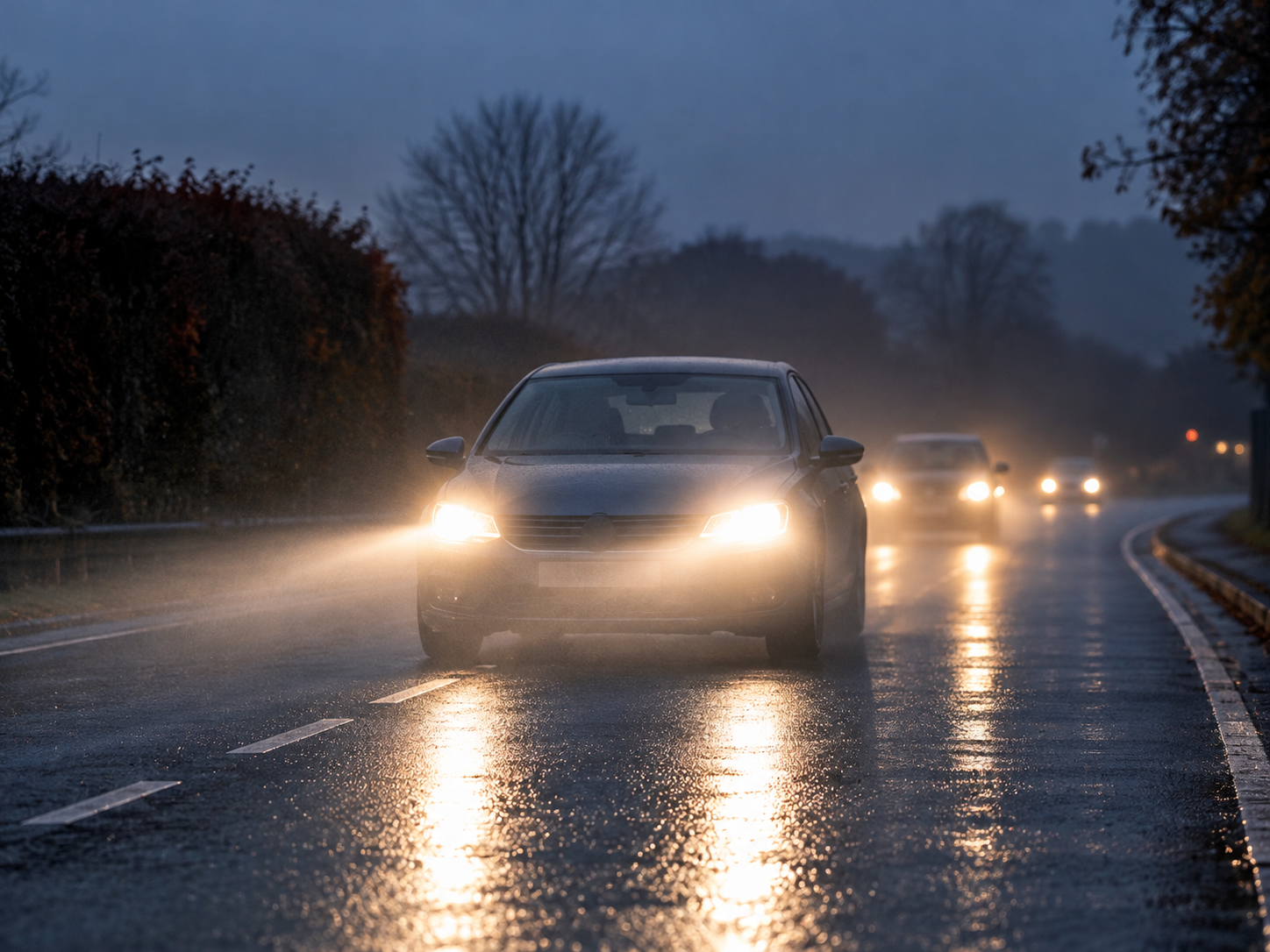
This distinction becomes particularly relevant during autumn, when reduced daylight, overcast conditions, rain and mist can affect visibility.
Automatic lighting systems provide additional functionality by detecting changes in ambient light and switching between lighting modes.
However, the response of these systems depends on vehicle design, sensor calibration and environmental conditions.
The presence of illuminated daytime running lights therefore does not necessarily indicate that a vehicle's full exterior lighting system is operating.
Advances in Automotive Lighting Technology
Vehicle manufacturers have introduced increasingly sophisticated lighting systems intended to improve illumination while managing the distribution of light around surrounding traffic.
LED headlights use light-emitting diodes to provide efficient illumination, with reduced electrical consumption compared with many traditional lighting arrangements.
Matrix LED systems use independently controlled lighting elements to modify the distribution of light. Depending on the system, selected sections of the beam can be reduced or switched off when other vehicles are detected.
Adaptive driving beam technology adjusts lighting distribution according to detected road and traffic conditions, potentially allowing greater forward illumination without continuously using a conventional dipped-beam pattern.
These developments represent significant advances in vehicle lighting design.
Nevertheless, the effectiveness of any headlamp system depends on factors including beam alignment, vehicle loading, road geometry and the position of surrounding road users.
Headlight Glare Remains Under Investigation
Despite advances in lighting technology, headlight glare continues to attract attention from motorists, researchers and transport authorities.
Research published by the Transport Research Laboratory (TRL) in October 2025 examined glare from vehicle lighting on UK roads.
The study included a survey of 1,850 drivers and an instrumented vehicle trial measuring lighting conditions during night-time journeys.
More than half of surveyed drivers reported having reduced or stopped driving at night because of headlight glare, or indicated that they would reduce their night-time driving if circumstances allowed.
The research also identified associations between reported glare and factors including light intensity, road location and vehicle positioning.
These findings demonstrate the complexity of the issue, rather than attributing glare exclusively to one particular lighting technology. TRL
Government Research and Future Regulation
The Department for Transport has continued examining the relationship between modern vehicle lighting and driver visibility.
In a parliamentary response published on 10 September 2026, the government confirmed that stakeholder engagement had been completed to inform a second phase of research into headlight glare.
The next phase is intended to examine vehicle design characteristics and potential measures to reduce glare.
The research may contribute to recommendations concerning international vehicle construction regulations.
No specific regulatory amendments arising from this second phase had been confirmed in that parliamentary response. UK Parliament
Current Position
The introduction of revised MOT requirements represents a development in the regulation of approved replacement lighting technology.
At the same time, continuing research into headlight glare highlights the importance of balancing improved road illumination with the visibility and comfort of other road users.
As autumn progresses and hours of darkness increase, vehicle lighting remains an important aspect of road safety.
Developments in LED technology, adaptive lighting and international regulatory standards are likely to remain subjects of technical and public discussion.
The current regulatory position distinguishes approved lighting modifications from unapproved conversions, while the broader question of headlight glare remains under investigation.
Official Sources
Driver and Vehicle Standards Agency
MOT Special Notice 05-26 — Approved LED Replacement Bulbs
Published: 13 October 2026
Department for Transport — UK Parliament
Parliamentary Response: Vehicle Headlight Glare Research
Answered: 10 September 2026
Transport Research Laboratory
Glare from Road Vehicle Lighting on UK Roads
Published: October 2025
Disclaimer
This article has been prepared using publicly available information from official organisations, industry publications and other publicly accessible sources available at the time of publication.
The ROBELIUM Newsroom provides editorial summaries intended to support general awareness of developments within the transport, mobility and roadside assistance sectors. Content does not constitute live traffic management, operational forecasting, route guidance, legal advice, safety advice or professional advice.
ROBELIUM is not affiliated with, endorsed by, or acting on behalf of any official transport authority, public body, road operator, emergency service or third-party organisation referenced in this article, unless explicitly stated.
Information, planned works, transport conditions and public announcements may change following publication. Readers should refer to the relevant official authority or original source for the latest updates where appropriate.