A mixed picture for road safety
The latest provisional road casualty figures present a difficult picture for Great Britain.
Department for Transport data estimates that 1,556 people were killed on Great Britain's roads during 2025, a reduction of 3% compared with 2024.
However, the number of people killed or seriously injured increased by 4% to 29,911.
There were 127,870 casualties of all severities, broadly unchanged from the previous year.
The distinction is important. Britain continues to make long-term progress in reducing road casualties, but serious injuries are not falling at the same rate.
Since 2022, fatalities have declined while the number of people killed or seriously injured has increased.
That trend is one of the reasons road-safety policy is increasingly moving beyond driver education and enforcement towards technology capable of preventing collisions or reducing their severity.
Motorcyclists remain a particular concern
The national figures also conceal significant differences between road-user groups.
Motorcyclists remain one of the most exposed groups on the road network.
Provisional figures show 384 motorcyclists were killed during 2025 — 13% more than in 2024.
The increase is particularly significant because vulnerable road users are one of the areas targeted by the next generation of vehicle safety systems.
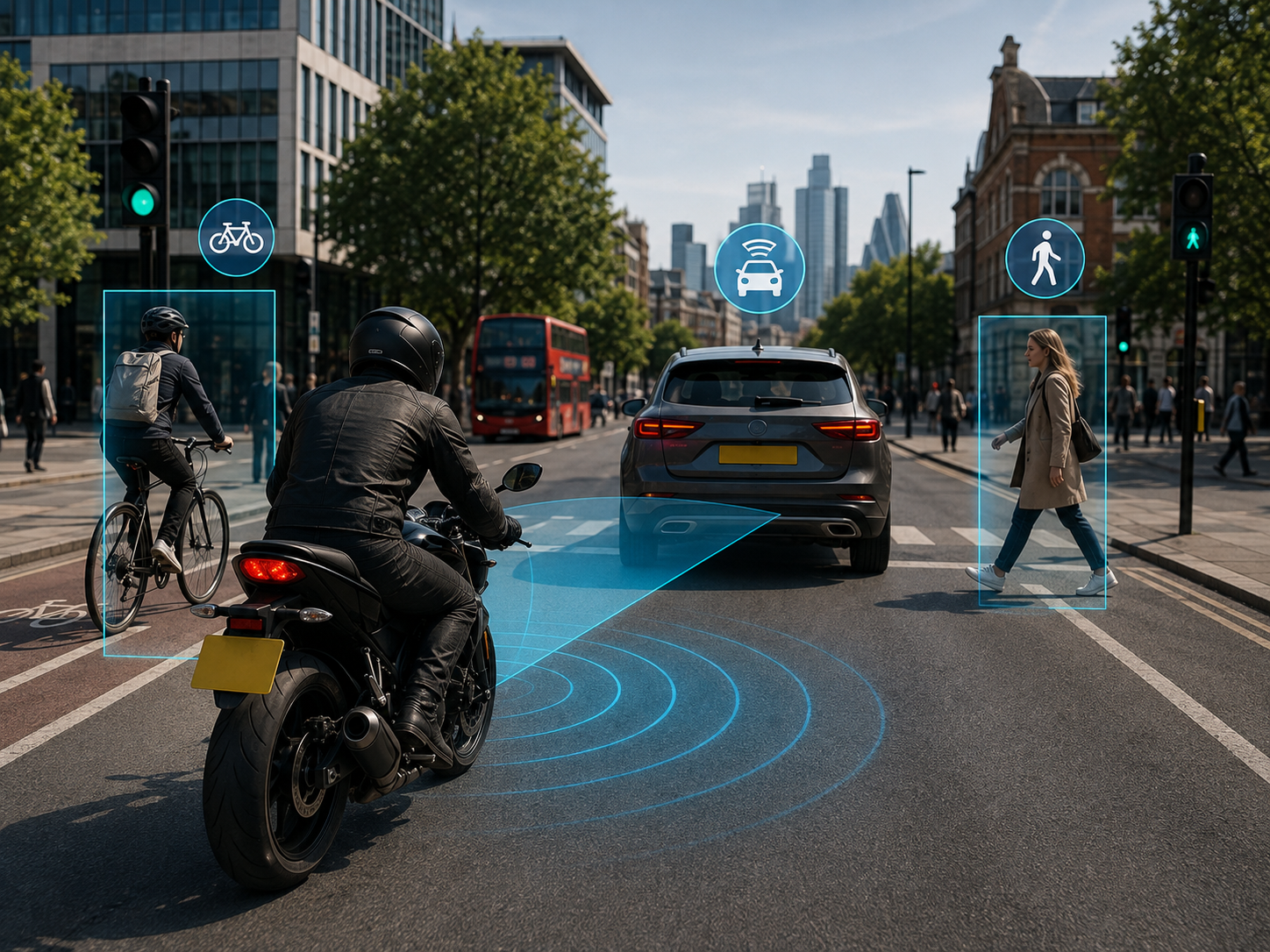
Systems capable of detecting motorcycles, cyclists and pedestrians in blind spots or during braking and manoeuvring are increasingly being treated as part of the vehicle's primary safety architecture rather than optional driver assistance.
Government confirms 18 safety technologies will be mandated
A significant development arrived in July.
Following a consultation launched alongside the Road Safety Strategy, the Government confirmed that it intends to proceed with 18 vehicle safety technologies for mass-produced vehicles receiving Great Britain type approval.
The consultation received 231 responses from individuals, manufacturers, automotive suppliers, insurers, road-safety organisations, motoring groups and public bodies.
Most supported the direction of the policy.
The technologies cover several different areas of collision prevention and occupant protection, including:
advanced driver-distraction warning
blind-spot information systems
driver drowsiness and attention warning
improved direct vision
emergency braking capable of responding to vehicles, pedestrians and cyclists
emergency lane-keeping systems
emergency stop signals
intelligent speed assistance
moving-off information systems
reversing detection
tyre-pressure monitoring
event data recorders
enhanced frontal, side and pedestrian-impact protection
The intention is not simply to protect people once a collision occurs.
Increasingly, the vehicle itself is expected to identify developing risks and intervene before an impact takes place.
Emergency braking and vulnerable-road-user detection
Some of the most important measures concern automatic emergency braking.
The proposed requirements include systems capable of responding not only to other vehicles but also to pedestrians and cyclists.
Blind-spot information and moving-off detection are intended to address another established risk, particularly where larger vehicles operate close to pedestrians and cyclists.
Reversing detection provides an additional layer of protection where visibility behind a vehicle is restricted.
Together, these technologies represent a shift towards vehicles continuously monitoring areas that drivers may temporarily fail to observe.
They do not remove driver responsibility.
Their purpose is to provide another opportunity to prevent a human error from becoming a serious collision.
Speed and driver attention
Human behaviour remains central to collision risk.
Distraction, fatigue and excessive speed continue to contribute to serious road incidents, and several of the technologies being taken forward directly address those factors.
Intelligent Speed Assistance uses information about applicable speed limits to warn or assist the driver when the vehicle exceeds them.
Advanced distraction-warning systems monitor signs that the driver's attention has moved away from the driving task, while drowsiness and attention systems are designed to recognise patterns associated with fatigue.
The Government consultation found more mixed views around systems that intervene directly in driving, particularly Intelligent Speed Assistance and emergency lane keeping.
Concerns included inaccurate detection, unnecessary intervention and drivers potentially losing confidence in systems that generate inappropriate warnings.
The Government nevertheless intends to proceed with the overall package while considering these real-world performance issues as the detailed legislation is finalised.
The timetable has changed
The July consultation response also provides greater clarity about implementation.
The Government has extended some of the proposed lead times following concerns from manufacturers and trade bodies.
Once the legislation enters into force, requirements for new GB vehicle types are intended to apply after 12 months.
For new registrations of complete vehicles, most technologies are intended to become applicable after 24 months, while direct-vision requirements and event data recorders will follow after 36 months.
Completed vehicles — including vehicles involving additional stages of manufacture — receive longer implementation periods.
Most technologies would apply to new registrations of completed vehicles after 36 months, with direct-vision requirements and event data recorders following after 48 months.
This means the transition will be phased rather than immediate.
Many vehicles already sold in Britain incorporate some or all of these technologies, but the new framework is intended to establish a more consistent safety baseline across mass-produced vehicles.
The next question: what happens after the vehicle leaves the factory?
One of the most significant elements of the consultation concerns something less visible than the technology itself:
maintenance.
Type approval confirms that a vehicle complies when it enters the market.
It does not guarantee that a camera, radar sensor, braking system or driver-assistance function will remain correctly calibrated and operational throughout the vehicle's life.
Consultation respondents repeatedly raised this issue.
Safety systems may be affected by collision repairs, windscreen replacement, suspension work, wheel alignment, sensor damage, software problems or incorrect calibration.
The consultation therefore examined whether these systems should be required to remain operational after registration.
A majority supported further action: 51.7% favoured making maintenance mandatory if evidence shows systems are not being maintained properly, while another 17.8% believed such a requirement should apply immediately regardless of future evidence.
The MOT was repeatedly identified as a possible mechanism for checking whether safety systems remain functional.
The Government has not yet committed to expanding the MOT specifically for these systems. Instead, it will monitor their performance and consider whether further action is required.
That distinction is important: mandatory ADAS testing through the MOT is not yet confirmed policy.
Repair and calibration become part of road safety
The consultation also raises a significant issue for the repair industry.
Respondents highlighted the need for independent repairers to have access to the technical information, diagnostic equipment, software, calibration procedures, replacement parts and training necessary to maintain these systems correctly.
This matters because modern safety technology increasingly depends on several vehicle systems working together.
A camera may identify a pedestrian.
Radar may determine distance.
Vehicle-speed information may calculate collision risk.
The braking system may then intervene.
If one component is incorrectly calibrated or unable to communicate correctly, the intended safety function may be compromised.
The Government says existing regulations already protect access to repair and maintenance information and that those requirements will need to continue evolving as vehicle technology changes.
Technology is only one part of the strategy
Vehicle technology forms one part of Britain's wider Road Safety Strategy.
Published in January 2026, the strategy establishes a target to reduce the number of people killed or seriously injured on Great Britain's roads by 65% by 2035, with a 70% reduction target for children under 16.
Alongside vehicle technology, the Government has been examining several other interventions.
These include a potential minimum learning period for new drivers, possible minimum supervised driving hours and a structured learning syllabus.
Motorcycle reforms under consideration include changes to compulsory basic training, a possible theory test before or during CBT, progressive licence training and changes to motorcycle instructor qualification.
For drivers aged 70 and above, another consultation has considered moving away from eyesight self-declaration towards mandatory eyesight testing during licence renewal.
The Government has also consulted on motoring offences covering drink and drug driving, seatbelt use, uninsured and unlicensed driving, failure to stop and report, vehicles without a valid MOT and illegal number plates.
Together, these measures show that the current road-safety programme is broader than vehicle technology alone.
It combines vehicle design, driver competence, enforcement, roadworthiness and infrastructure.
From safer cars to a safer system
Advanced driver-assistance technology cannot eliminate road collisions.
Drivers can misunderstand systems. Sensors can become damaged. Road markings can deteriorate. Technology can produce incorrect interventions and safety systems can be disabled or poorly maintained.
The Government's consultation acknowledges many of those limitations.
But the direction of policy is becoming clearer.
Safety is moving away from relying primarily on the person behind the wheel towards a layered system in which drivers, vehicles, infrastructure, enforcement and maintenance each provide protection when another part of the system fails.
That is particularly relevant as serious injuries continue to move in the wrong direction despite the gradual reduction in fatalities.
ROBELIUM Observation
The latest casualty statistics and the July vehicle-safety decision should be considered together.
Great Britain recorded fewer road deaths in 2025, but 29,911 people were killed or seriously injured — 4% more than the previous year.
The Government's decision to proceed with 18 vehicle safety technologies therefore represents more than another equipment requirement for new vehicles.
It signals a change in where responsibility for collision prevention is being placed.
Vehicles are increasingly expected to detect distraction, recognise vulnerable road users, monitor blind spots, identify excessive speed and intervene when a collision becomes imminent.
But fitting the technology is only the first stage.
If these systems are expected to prevent serious injuries throughout a vehicle's working life, diagnosis, repair, calibration and roadworthiness will increasingly become part of road-safety policy as well.
That may ultimately prove one of the most important consequences of the current reforms for the wider automotive, fleet and roadside sectors.
Disclaimer
This Industry Intelligence article has been prepared using publicly available information from the Department for Transport available at the time of publication.
The ROBELIUM Newsroom provides editorial summaries intended to support general awareness of developments affecting road transport, vehicle safety and roadside mobility. Provisional casualty statistics may be revised, while consultation outcomes may require subsequent legislation before measures become legally binding.
Readers should consult the relevant government or transport authority for current official information.