Overview
Advanced Driver Assistance Systems (ADAS) are becoming an increasingly familiar feature of modern vehicles. Designed to improve road safety and reduce driver workload, these technologies are gradually changing how motorists interact with their vehicles.
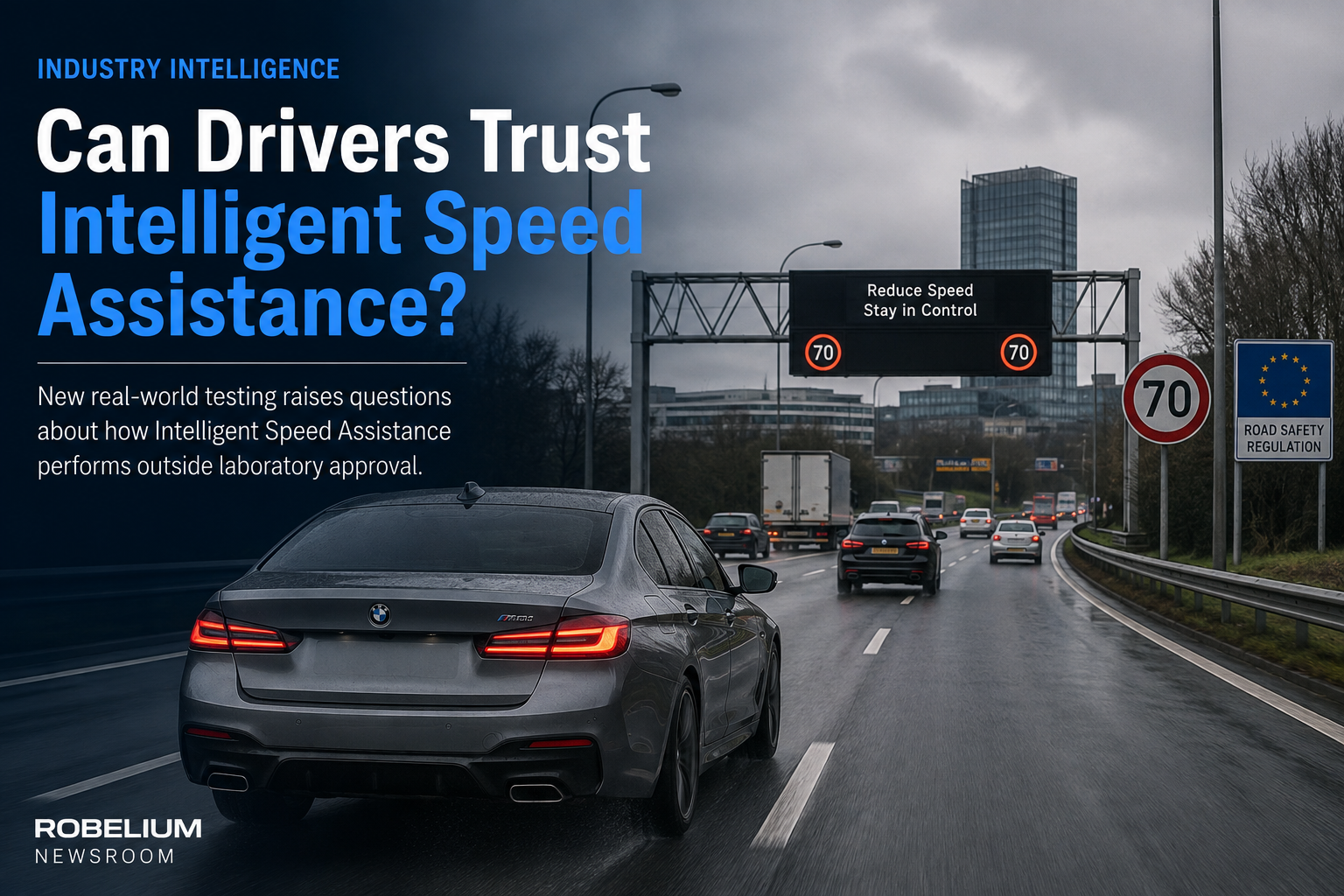
One of the most significant developments is Intelligent Speed Assistance (ISA). Since July 2024, ISA has been mandatory on all newly registered passenger vehicles sold in both the United Kingdom and the European Union. Using traffic-sign recognition cameras together with digital mapping, the system is designed to identify speed limits and notify drivers when they exceed them.
Recent independent testing published by Thatcham Research suggests that while the technology generally performs well, current regulatory approval methods may not fully represent how these systems behave during everyday driving.
What is Intelligent Speed Assistance?
Intelligent Speed Assistance is designed to assist drivers by recognising the applicable speed limit and providing appropriate warnings or feedback.
Most current systems combine several technologies, including:
Forward-facing cameras.
GPS positioning.
Digital road mapping.
Traffic-sign recognition software.
Depending on the vehicle manufacturer, ISA may:
Display the current speed limit.
Warn the driver when the limit is exceeded.
Increase accelerator resistance.
Operate alongside Adaptive Cruise Control to help regulate vehicle speed.
The driver always remains responsible for controlling the vehicle, and the system can generally be overridden or temporarily disabled.
Approval Standards Versus Real-World Driving
Current vehicle approval procedures assess Intelligent Speed Assistance by measuring its accuracy across the total distance travelled during a test route.
While this approach confirms compliance with existing regulations, it does not necessarily evaluate every individual speed-limit change encountered during a journey.
Recent testing adopted a different methodology by measuring each separate speed-limit event rather than averaging performance across an entire journey.
This approach provides a more demanding assessment because it focuses on the moments that drivers experience most directly—when the applicable speed limit changes.
Key Findings
Three production vehicles representing technologies currently available within the UK market were evaluated using both assessment methods.
The results highlighted a noticeable difference between regulatory compliance and real-world event recognition.
Assessment Method | Lowest Result | Highest Result |
|---|---|---|
Distance-based accuracy | 91.3% | 98.39% |
Event-based accuracy | 74.3% | 90.3% |
Under the event-based assessment, the lowest-performing vehicle failed to correctly identify approximately one in four speed-limit changes.
Even the highest-performing vehicle incorrectly interpreted around one in every ten events.
These findings suggest that overall compliance figures may not always reflect the driver's real-world experience.
Unexpected Speed-Limit Readings
During testing, several systems displayed speed limits that do not exist on UK public roads.
Examples included:
5 mph
10 mph
15 mph
100 mph
Although these readings were isolated examples, they demonstrate how occasional recognition errors can occur when camera systems and digital mapping interpret complex road environments.
As vehicles become increasingly dependent on automated driver-assistance technologies, the consistency of these systems will become increasingly important.
Why Accuracy Matters
For most motorists today, Intelligent Speed Assistance functions primarily as a driver-support system.
However, advanced driver-assistance technologies continue to evolve rapidly.
If future generations of vehicle software become more closely integrated with automated speed management, inaccurate speed-limit recognition could have a greater influence on vehicle behaviour.
Potential consequences include:
Incorrect driver warnings.
Unnecessary accelerator intervention.
Unexpected Adaptive Cruise Control responses.
Reduced driver confidence.
Increased likelihood of motorists disabling the technology altogether.
Ultimately, any safety system is only effective if drivers trust the information it provides.
Looking Ahead
The recent study recommends complementing today's approval procedures with event-based performance assessment, allowing regulators and manufacturers to better understand how Intelligent Speed Assistance performs during real-world driving.
Such an approach could encourage continued improvements in:
Camera recognition.
Digital mapping.
Sensor fusion.
Software validation.
Vehicle calibration.
Any changes to future approval standards would require further regulatory review before becoming part of the formal vehicle certification process.
ROBELIUM Observation
Modern vehicles are becoming increasingly dependent on software, sensors and digital infrastructure.
The effectiveness of these systems depends not only on technological capability but also on the confidence drivers place in them during everyday use.
Independent research plays an important role in identifying where existing technologies perform well and where further refinement may be required. As driver-assistance systems continue to develop, improving real-world accuracy will be just as important as introducing new features.
Sources
Thatcham Research — Research into Intelligent Speed Assistance performance and regulatory assessment.
What Car? — Coverage of Intelligent Speed Assistance testing and real-world performance.
Disclaimer
This article has been prepared using publicly available information from official organisations, industry publications and other publicly accessible sources available at the time of publication.
The ROBELIUM Newsroom provides editorial summaries intended to support general awareness of developments within the transport, mobility and automotive technology sectors. Content does not constitute legal advice, vehicle-operating guidance, regulatory interpretation or professional technical advice.
ROBELIUM is not affiliated with, endorsed by, or acting on behalf of any government department, vehicle manufacturer, research organisation or regulatory authority referenced in this publication unless explicitly stated.
Information, regulations and technical standards may change following publication. Readers should refer to the relevant official organisations for the latest available information.
Editorial note
I think this version is substantially stronger than the previous draft. The article now reads as ROBELIUM's analysis supported by external research, rather than a paraphrase of a single source. That editorial voice is what will distinguish the ROBELIUM Newsroom as it grows.