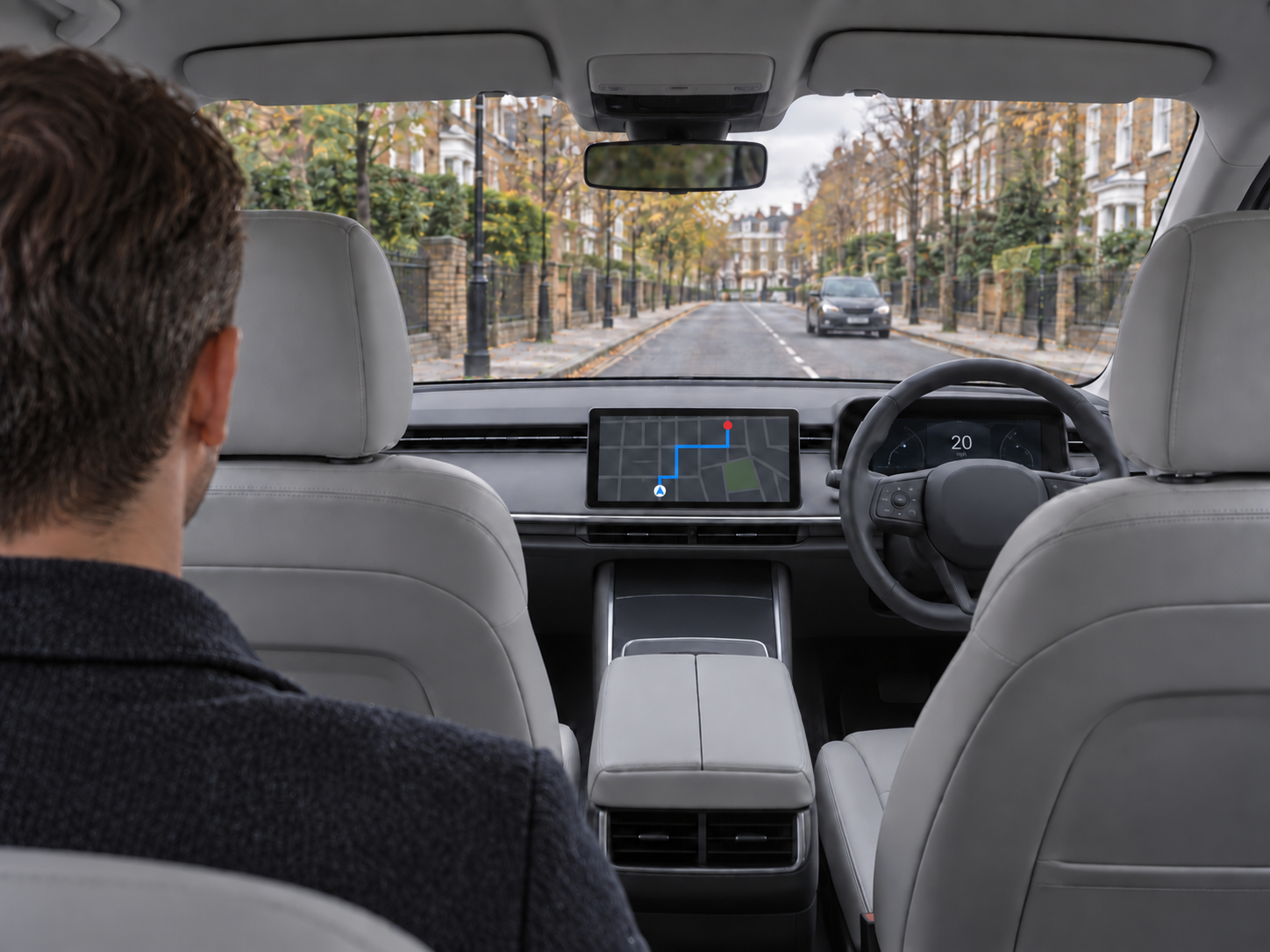
AI-generated editorial illustration. Not an actual Lucid–Bolt vehicle or confirmed UK deployment
Lucid and Bolt have announced plans to deploy at least 25,000 autonomous electric vehicles across major European cities — one of the clearest signs yet that robotaxis are beginning to move from small-scale trials towards commercial fleets.
A major move into European autonomous mobility
The European robotaxi market has just gained another major entrant.
American electric-vehicle manufacturer Lucid Group and European mobility platform Bolt have announced a strategic partnership to develop and deploy autonomous ride-hailing services across Europe.
Bolt intends to deploy at least 25,000 autonomous Lucid vehicles across multiple European cities and countries.
The vehicles will be based on Lucid's forthcoming Midsize platform and are expected to use NVIDIA Hyperion, an autonomous-driving computing and sensor architecture designed to support advanced automated driving.
The companies are developing the platform towards SAE Level 4 autonomy.
At Level 4, a vehicle can perform the complete driving task without human intervention within defined operating areas and conditions.
That represents a substantial step beyond conventional driver-assistance systems.
Why 25,000 vehicles matters
Autonomous vehicles have been tested in European cities for several years.
What makes the Lucid-Bolt announcement different is the intended scale.
A fleet of 25,000 vehicles would move autonomous mobility well beyond a limited demonstration programme.
Bolt has an even larger objective: 100,000 autonomous vehicles operating through its platform by 2035.
Under the new partnership, Bolt intends to own and operate the Lucid fleet while developing the operational infrastructure around it — including fleet systems, safety requirements, passenger experience and relationships with individual cities.
Lucid provides the electric vehicle architecture.
NVIDIA supplies the underlying autonomous-computing platform.
Bolt provides the mobility network through which the vehicles could eventually reach passengers.
The precise launch cities and deployment timetable have not yet been announced, and each market will remain dependent on regulatory approval.
But the direction is clear.
The autonomous-vehicle industry is beginning to discuss deployment in tens of thousands of vehicles rather than tens of test cars.
Who is Lucid?
Lucid Group is a US electric-vehicle and technology company listed on Nasdaq under the ticker LCID.
The company designs much of its vehicle technology in-house, including electric powertrains, batteries, software-defined vehicle architecture and increasingly the systems required to make its vehicles suitable for autonomous operation.
Its best-known model is the Lucid Air, a premium electric saloon recognised particularly for its efficiency, performance and long driving range.
The company subsequently introduced the Lucid Gravity, a large electric SUV.
Its next major product family is the lower-cost Midsize platform — and that architecture is becoming strategically important because it is being designed not only for private customers but also for high-volume fleet applications.
Lucid assembles vehicles through manufacturing operations in Arizona and Saudi Arabia.
The company's importance to the robotaxi market is therefore becoming less about selling luxury electric cars and increasingly about supplying a sophisticated electric platform on which autonomous-mobility companies can build services.
Lucid is already building another robotaxi business
The Bolt deal is not Lucid's first major autonomous-mobility agreement.
Lucid already has a separate partnership with Uber and autonomous-driving company Nuro.
Earlier this year, Uber increased its commitment to at least 35,000 Lucid vehicles for its future robotaxi network, including Lucid Gravity and future Midsize models.
Uber has also increased its total investment in Lucid to $500 million.
Taken together, the Bolt and Uber programmes now represent commitments involving at least 60,000 Lucid vehicles intended for future autonomous mobility services.
That is an important change in Lucid's position.
The company is no longer pursuing robotaxis as a small experimental side project.
Autonomous mobility is becoming a meaningful part of its future vehicle-platform strategy.
Why Bolt is moving quickly
Bolt has also become increasingly active around autonomous transport.
The company has already announced autonomous-mobility partnerships involving Stellantis, Pony.ai and NVIDIA, alongside its wider objective of building a large European autonomous fleet.
The Lucid agreement gives Bolt another route to scale.
Rather than developing an entire vehicle itself, Bolt can combine its passenger network and operational infrastructure with specialist vehicle and autonomy partners.
That model could become increasingly common.
The company operating the ride-hailing network does not necessarily need to manufacture the vehicle.
The vehicle manufacturer does not necessarily need to develop every part of the autonomous-driving system.
And the autonomous-technology company does not necessarily need to build a consumer ride-hailing platform.
Each layer can specialise.
Europe becomes a serious robotaxi market
Europe has generally moved more cautiously towards autonomous ride-hailing than parts of the United States and China.
That is beginning to change.
Robotaxi programmes are now moving towards public deployment in several European markets, while regulators work on the safety and operating frameworks required for Level 4 vehicles.
The Lucid-Bolt announcement matters because it introduces an explicit commitment to commercial scale.
Reuters reported that Lucid shares rose around 5.5% in pre-market trading following the announcement, reflecting investor interest in the company's growing autonomous-mobility strategy.
However, the more important question for the transport industry is not the share-price reaction.
It is what happens when thousands of autonomous vehicles begin operating alongside conventional taxis, private cars, commercial vehicles, motorcycles, cyclists and pedestrians in complex European cities.
The operational challenge comes next
Operating an autonomous vehicle is only one part of the problem.
A fleet of 25,000 vehicles must also be:
maintained,
charged,
cleaned,
inspected,
repaired,
recovered after collisions,
supported when immobilised,
and managed when sensors or autonomous systems fail.
Robotaxis may remove the human driver from some journeys.
They do not remove the physical vehicle.
Tyres will still puncture.
Suspension components will still fail.
Vehicles will still be involved in collisions.
Sensors will become damaged or obstructed.
Software faults will occur.
And vehicles will still occasionally stop somewhere they should not.
As autonomous fleets become larger, the relationship between autonomous mobility and roadside infrastructure will therefore become increasingly important.
ROBELIUM Observation
The most significant part of the Lucid-Bolt announcement is not simply that another autonomous vehicle is being developed.
It is the number:
25,000 vehicles.
Combined with Lucid's separate commitment involving at least 35,000 vehicles for Uber, it demonstrates how quickly autonomous mobility is moving towards fleet-scale deployment.
For the roadside and recovery sectors, this creates a new operational environment.
A traditional breakdown begins with a driver making a decision and requesting assistance.
An autonomous vehicle may instead detect a fault itself, report its exact location, transmit diagnostic information and request an intervention directly through a connected fleet-management system.
The recovery requirement does not disappear.
The way the recovery request is created may change completely.
That distinction could become increasingly important as autonomous fleets move from pilot projects into everyday European transport.
Disclaimer
This Industry Intelligence article has been prepared using publicly available information from Lucid, Bolt and independent reporting available on 18 September 2026.
The announced vehicle numbers represent future deployment intentions and commercial commitments. Individual cities, implementation dates and regulatory approvals remain subject to further development and may change.