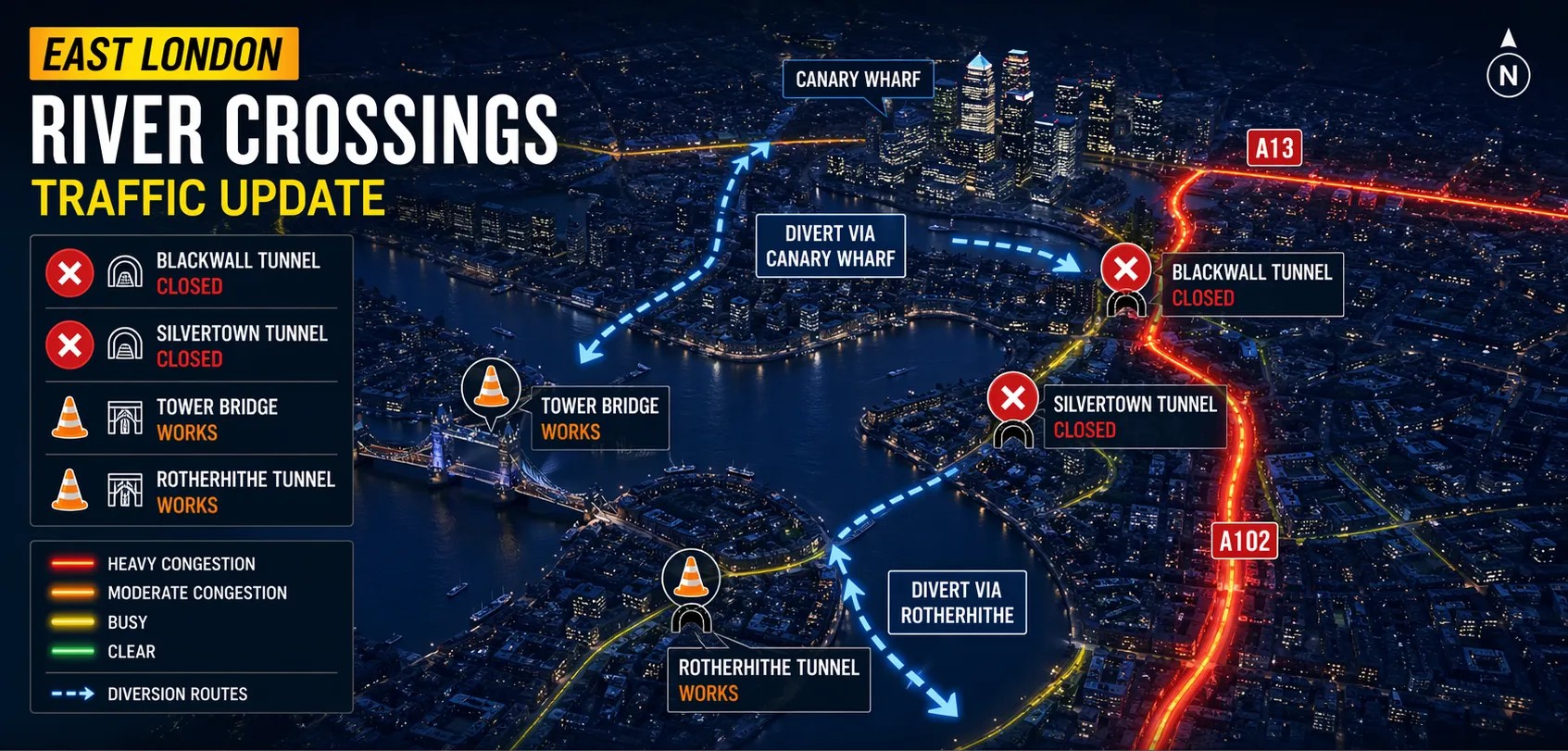
East London’s river crossings are entering a predictable overnight disruption cycle, as scheduled Blackwall Tunnel closures combine with ad-hoc Silvertown works to create recurring congestion across key A102, A13 and Canary Wharf corridors.
🔴 Blackwall Tunnel: Structured Night Closures
According to Transport for London disclosures, regular overnight closures (22:00–05:00) are now embedded into the network:
Northbound closures: 1st & 2nd Tuesday each month
Southbound closures: 3rd & 4th Tuesday each month
Works extend across the A102 approaches and feeder routes
📌 Impact:
Traffic is displaced onto A12, A13, Canary Wharf routes, Greenwich Peninsula
Expect build-up pre-closure (from ~20:30 onward) and slow recovery after reopening
🟠 Silvertown Tunnel: Ad-hoc Overnight Works
Silvertown is running non-fixed, recurring night works, typically:
Closure windows: ~21:00–04:00 / 22:00–05:00
Both directions impacted intermittently
Maintenance tied to post-opening adjustments (“snagging”)
📌 Key behaviour:
No stable schedule → less predictable than Blackwall
Closures often overlap with Blackwall approach restrictions
🔁 Diversions & Network Effects
When closures hit:
Silvertown traffic diverts → Blackwall
Full closures push vehicles toward:
Rotherhithe Tunnel
Tower Bridge
Woolwich Ferry
📌 Result:
Localised works → network-wide congestion ripple
East London crossings behave like a single stressed system, not isolated routes
⚠️ Additional Pressure Points (Live Network Context)
👉 https://tfl.gov.uk/traffic/status
Long-running works (e.g. A206 Woolwich Road, Nine Elms Lane, Lambeth Bridge) continue into 2026
These reduce alternative route capacity, amplifying tunnel disruption impact
🧠 Operational Take (What Actually Matters)
This isn’t a random disruption anymore.
👉 You’re looking at a repeatable pattern:
Fixed Blackwall closure cycle
Variable Silvertown works layered on top
Limited alternative crossings already under pressure
Bottom line:
East London overnight traffic is now systemically fragile, with predictable congestion spikes tied to tunnel engineering windows—not incidents.